Samad's House Frontline Voices
Summer 2026 Newsletter
The numbers tell a hopeful story. For the third straight year, drug overdose deaths in Milwaukee County have fallen. In 2025, the county recorded 387 fatal overdoses, down a striking 42.6% from the 2022 peak of 674 deaths. Opioid-related deaths dropped even more sharply, with 249 recorded last year compared to 548 in 2022 — a decline of more than half.
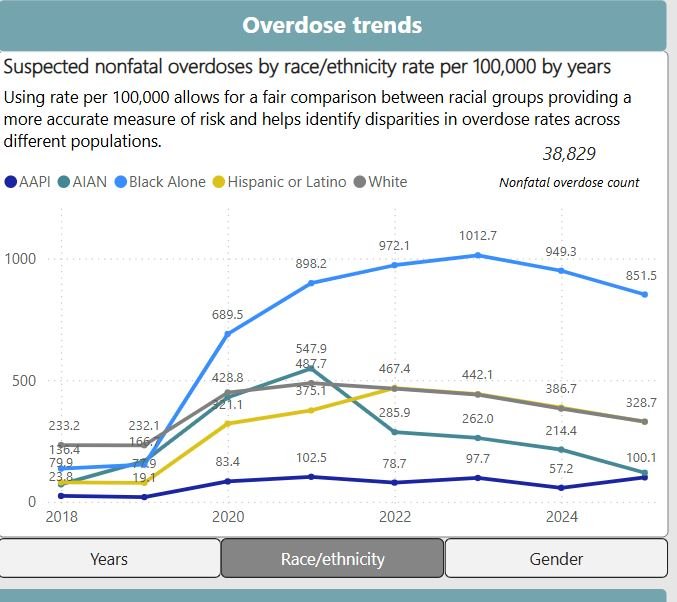
County officials call it proof that their investments are working. More money spent on harm reduction, treatment, and prevention has translated into lives saved. But look closer at the data, and a harder truth emerges. The progress hasn't reached everyone equally. In Milwaukee's Black communities, people are still dying at rates that far outpace their white neighbors.
Of the 387 people who died from overdoses in Milwaukee County in 2025, 147 were Black and 184 were white. On the surface, those numbers might look close. But they hide a painful disparity. Black residents died at a rate of 59.7 per 100,000 people. For white residents, that figure was 38.5 per 100,000 even though the two groups use drugs at the same rates.
In other words, a Black person in Milwaukee County was significantly more likely to die from an overdose than a white person — even as the overall trend moved in the right direction and both communities use drugs at similar rates. This gap isn't unique to Milwaukee. Across the country, overdose deaths have started to fall, yet Black communities continue to shoulder a disproportionate share of the loss.
What's Driving the Decline
Dr. Ben Weston, Milwaukee County's chief health policy adviser, credits harm reduction for much of the good news. Speaking in April, he pointed to concrete tools the county has rolled out — vending machines stocked with naloxone and drug-testing strips, along with a state-sponsored data-collection system that helps local health departments pinpoint when and where overdoses occur.
The strategy is well planned. Increase access to life-saving supplies, remove the financial barriers that keep people from getting them, and chip away at the stigma that stops people from using them. The Milwaukee County Department of Health and Human Services has pushed these supplies into the community through multiple programs, and the results show up on the county's public Overdose Dashboard.
The data confirms the trend. Fatal overdoses dropped 17.7% from 2024 to 2025, and fatal opioid overdoses fell 22.7% in that same window. These are real gains, built on evidence-based practices.
Alan Robinson, operations manager for PULSE and executive director of the Satori Recovery Project, sees the proof in the numbers. "Overdose deaths coming down in total numbers is evidence that harm reduction is working," he says. "These evidence-based practices being implemented work."
Credit: Milwaukee County Office of Emergency Management
The Barriers Black Communities Face
So why hasn't that success spread evenly? The answer lies in a tangle of history, mistrust, and misconceptions that have built up over decades.
For years, community leaders, government agencies, and health care professionals were slow to recognize rising overdose rates among Black residents. There was a persistent, mistaken belief that overdose prevention wasn't relevant to Black communities. That belief was structural racism at work — a system of policies and practices that disadvantaged people of color and widened the gaps. As overdose deaths climbed in Black communities over the past decade, deaths among white Americans began to fall. The result: Black communities kept experiencing disproportionately high death rates driven by systemic inequities, limited awareness, and scarce prevention resources.
Traditional harm reduction and treatment programs have often failed to reach Black residents because they weren't built with those communities in mind. Without culturally specific outreach, Black families and individuals used these services less. Misinformation and stigma around addiction made people reluctant to ask for help. A long history of discrimination and mistreatment in health care settings left many Black patients deeply distrustful of providers.
Fear of legal consequences deepens that distrust. Federal drug policies have historically criminalized drug use in Black communities far more harshly than elsewhere. As a result, Black people are less likely to seek life-saving help or take part in overdose prevention programs. The share of Black residents who received substance use disorder treatment has consistently trailed that of their white counterparts.
Much of this traces back to a single, sweeping policy failure.
"The war on drugs punished Black communities, leaving a legacy of stigma, mistrust, and unequal treatment," relates Adrienne Hurst, Senior Technical Advisor for Overdose Prevention Program at Vital Strategies, a global health organization supporting harm reduction approaches. “Over the decades, Black people in Milwaukee and across the country have faced harsher drug sentencing and mass incarceration instead of support. We must break that cycle by embracing public health policies and strategies that empower and protect our communities, support harm reduction, and break away from the war on drugs mentality.”
The Stimulant Problem
There's another layer to Milwaukee's disparity, one that harm reduction programs are only beginning to address. Tahira Malik, founder of Samad's House — one of the Midwest's leading sobriety homes for women — points to a dangerous shift in the drug supply.
"Historically, African Americans are stimulant users," Malik explains. "And our community, even though they are aware of the effects of fentanyl, they still aren't aware of how detrimental it is to the stimulants, and it causes a speed-balling effect."
That combination is lethal. When fentanyl contaminates stimulants like cocaine, users who never intended to touch opioids can die.
Malik noted that there are things people can do to reduce harm if they use drugs after testing positive for fentanyl, such as using slowly and not using alone, so someone can help if needed.
Cultural Resistance and the Faith Community
Robinson, who is based in the Madison, Wisconsin area, believes part of the problem is that harm reduction hasn't been fully embraced within Black communities themselves — especially among the faith-based organizations that do so much of the substance use work.
"Culturally, particularly in the Black community, there has been real pushback on harm reduction because it feels antithetical to provide safe smoking supplies to someone who has a crack cocaine substance use issue," he says. "It seems on its face it appears antithetical. But it isn't in practice."
The instinct, Robinson says, has been to push recovery first. And that approach has limits. "You can't choose recovery for anyone. People have to choose recovery for themselves, and when they choose recovery, that's when it becomes effective. The idea of harm reduction is to keep people alive. "
He also challenges a common misconception. "The idea that Black people smoke their drugs more than white people — well, that's just not true." Smoking, he adds, is itself a form of harm reduction, since it's less likely to cause a fatal overdose than injecting. Robinson worries, too, that government efforts to "put a Black face on substance use" can ring hollow, leaving people across the spectrum without the services they actually need.
Real change, he argues, will require "a fundamental paradigm shift from the folks that are doing the work on the ground in the Black community to really embrace harm reduction."
A Path Forward
Clearly, in Milwaukee, the disparities in overdose deaths indicate that harm reduction resources alone aren’t enough to prevent drug fatalities. Milwaukee has received high marks for improving access to naloxone in recent years. But even when governments and non-profits provide accessible naloxone, social determinants of health, such as affordable housing, healthcare, and jobs, put residents at greater risk of substance disorders.
The good news is that it’s clear what strategies work to decrease overdose deaths. What’s also needed is the will to apply them equitably.
Founded by Malik in 2020, Samad’s House is at the forefront of this fight. What began as a single sober living home has grown into a network of three homes and a behavioral health clinic, providing comprehensive services to help women and families maintain sobriety. Over the years, Samad’s House has transformed the lives of more than 75 women and nearly a dozen families, while distributing over 2,300 naloxone kits and fentanyl test strips since 2024.
Malik communicates with the county about how to save lives.
"The health department called me recently to discuss the numbers and what we can do to bring them down," she says, referring to Black overdose deaths. "The answer has to be more harm reduction, more education, more naloxone, and more test strips."
But she's clear that supplies alone won't fix the problem. The roots run deeper. "We also need to address the other issues that are stressing people out and driving them to drugs. Our communities need more housing, more jobs, and more access to affordable healthcare. Once we make progress on these issues, we will save lives. People won't be so desperate, and we can help them look to other things besides drugs."
Dismantling these structural barriers calls for a comprehensive approach: developing culturally specific outreach and treatment programs, building genuine trust between Black communities and health care providers, ensuring equitable access to medication and treatment, and confronting the socioeconomic inequities that fuel the crisis in the first place.
“Milwaukee County's declining overdose numbers prove that harm reduction works,” Malik says. “The challenge now is making sure that progress belongs to everyone. Because the third straight year of improvement means little if the people dying at the highest rates are still being left behind.”