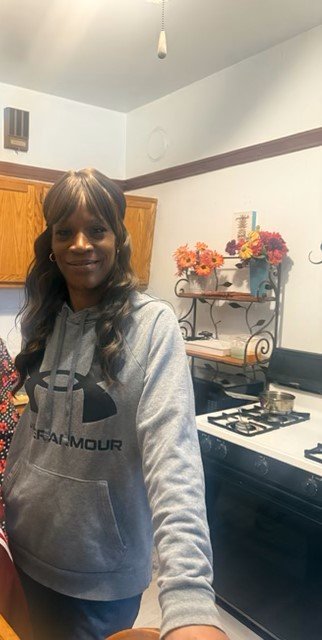
At 49, Delores Omole has faced experiences that could have broken her, but instead, they have shaped her into a savior for others. Today, as an ambassador for Samad’s House, she uses her voice and her determination to overcome a substance disorder and domestic abuse to inspire women who are navigating similar struggles.
Last fall, Delores arrived at Samad’s House in the depths of despair. After relapsing into alcohol and substance use and finding herself trapped in an abusive relationship, she felt her life spiraling out of control. “I completely lost who I was,” Delores recalls. “I didn’t know what love was anymore. My fear and anxiety were through the roof. I was isolated, broken, and numb.”
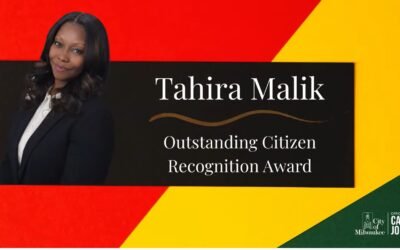
Her days were consumed by a toxic cycle of alcohol, substance use, and emotional pain. “I was drinking and smoking to die,” she acknowledges. “Every morning, I would wake up and think, ‘I woke up again.’” The weight of her circumstances pushed her to the brink, but she refused to surrender. A glimmer of hope led her to Tahira Malik, the founder of Samad’s House, one of the Midwest’s leading sober-living facilities for women and a harm-reduction hub.
Delores had been to Samad’s House years before but left prematurely, a decision she later regretted. This time, she was determined to stay and heal. “When I walked through those doors again, I was a hot mess,” she says. “But they made me feel safe. They gave me back my self-worth and showed me that what I was going through wasn’t normal—and it never would be.”
Founded by Tahira Malik in 2020, Samad’s House has emerged as a cornerstone in Milwaukee’s fight against substance use disorders and overdose deaths, particularly in Black communities disproportionately affected by the epidemic, even though their drug use is similar to that of whites. The organization provides a safe, supportive haven for women to rebuild their lives. With three homes and a behavioral health clinic, Samad’s House offers a comprehensive 120-day intensive program that addresses the mind, body, and spirit.
For people facing substance disorders, as Delores was, Samad’s House provides a caring, comforting residential environment for those who have decided to seek sobriety. It’s critical that Samad’s House also distributes compassionate harm-reduction resources, such as life-saving naloxone and fentanyl test strips, to community members who haven’t made that step yet, meeting them where they are and enhancing their safety.
Drawing on her lived experience, Malik has developed a holistic treatment approach that goes beyond traditional methods. One of her most innovative and impactful initiatives is the Samad’s House Ambassador Program, which empowers graduates of the treatment program to become trusted messengers in their communities. These ambassadors, such as Delores, are trained in harm-reduction tools and provide resources, support, and hope.
“Our ambassadors use their street smarts and lived experiences to teach others about harm reduction,” Malik explains. “They save lives. They address the overdose crisis that has devastated Black families and communities in Milwaukee.”
For Delores, becoming an ambassador was a natural progression during her healing journey. “I just be myself,” she says humbly. “I’m an example of what can happen if you decide to change your life. I share my story to show others that there is a light at the end of the tunnel.”
As an ambassador, Delores accompanies Malik to events, connects with women in crisis, and helps bring them into Samad’s House’s supportive community. She also provides emotional support and practical advice, drawing from her own experiences. “I talk about coping skills, dealing with anxiety and trauma, and how to work through it,” she says. “I want to be that voice that tells women there is hope and that they don’t have to suffer in silence.”
Delores recalls a particularly poignant moment when she helped Bridget, who was on the verge of leaving Samad’s House after just a few days. “She was broken, crying in the kitchen,” Delores remembers. “I gave her a big hug and told her, ‘It gets better. Trust me, we’ve all felt this pain, but if you stay, you’ll feel safe, and then you’ll be free.’” Bridget stayed, and the two women formed a bond that continues to this day. “She’s like my big sister now,” Delores says with a smile.
The work of Samad’s House and its ambassadors is life-changing, not only for the women they serve but also for the broader community. They address substance disorder, domestic violence, and other challenges vulnerable women face. “Our ambassadors are trusted messengers because they’ve lived it,” Malik says. “They know what it’s like to be judged, stigmatized, and written off. That gives them a level of empathy and compassion that can’t be taught.”
This empathy is evident in Delores’ interactions with the women she helps. She understands their fears, their pain, and their hesitation to trust. “It’s hard to open up,” she says. “But I tell them, ‘You’re not weak. You’re not alone. And you don’t have to stay stuck.’”
Samad’s House Ambassadors equip women with the tools and confidence to make a difference. They are trained to navigate the complexities of the path toward recovery. “They help people live another day,” Malik says. “And sometimes, that’s all it takes to start turning things around.”
Samad’s House has made significant strides – over 75 women and nearly a dozen families have reclaimed their lives since they opened their doors. Since 2024, Samad’s House has dispersed over 2,300 naloxone packages and fentanyl test strips to the community. But like other organizations providing harm-reduction services and tools, they face significant challenges, particularly in sustaining funding. President Trump cast a cloud over the harm-reduction approach last summer when he directed the federal government to defund those efforts.
“Users must be treated with compassion,” insists Malik, who overcame a substance disorder and is now committed to helping others. “We need funding to be sustained and distributed equitably so that lives can be saved in all communities.” She remains steadfast in her mission. “Harm reduction is about dignity and practical support. It’s about meeting people where they are and giving them the tools to survive and thrive.”
For Delores, the work is deeply personal. “Samad’s House saved my life,” she says. “When I say that, I mean it with every fiber of my being. They gave me the courage to walk out of that abusive relationship and the tools to rebuild my life. Now, I want to give that back to others.”
Her experience demonstrates the power of community, compassion, and second chances. She has gone from feeling hopeless and broken to becoming a source of hope and strength for others. “I want women to know that there is a safe place and safe people,” she says. “Even if it’s the last person you ever expected to tell, reach out. Speak about it. Because if you don’t, you’ll stay stuck—and I don’t want that for anyone.”
Reflecting on her journey, Delores is deeply grateful to Malik and the team at Samad’s House. “If I could put Tahira on a billboard, I would,” she says. “Tahira and her family have done so much for me and so many others. They bring out the best in you. It’s already in you, but they help you find it.”
Through her work as an ambassador, Delores pays it forward, one woman at a time. Her message is simple but powerful: “There is hope. There is help. And you are worth it.”